
Credit fraud and identity theft: how effective are document checks?
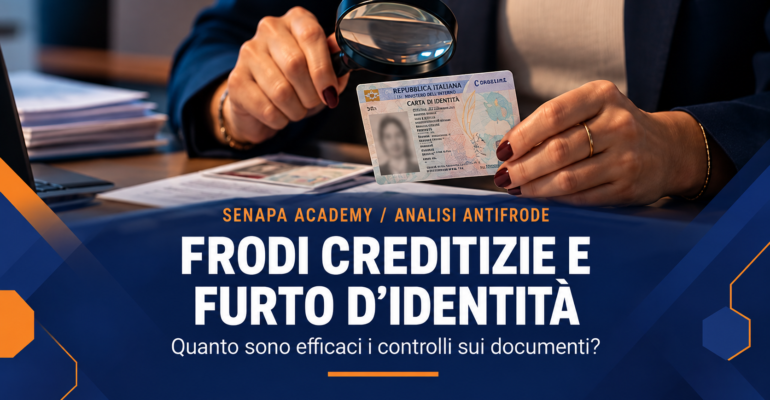
Credit fraud and identity theft: how effective are identity checks?
Credit fraud linked to identity theft continue to rise. According to the CRIF – Mister Credit Observatory, in 2025 In Italy, the following have been recorded over 38,300 cases, totalling more than 165 million euros. Behind many of these transactions lies the unlawful use of another person’s personal data, sometimes involving forged or altered documents. How can you spot a forged document? What checks should an operator carry out? And what changes will the new provisions on the validity of paper identity cards bring?
Credit fraud in Italy: CRIF figures for 2025
According to theCRIF Observatory – Mister Credit, in 2025, over 38,300 cases of credit fraud involving identity theft, representing a 23.8% increase compared with 2024.
The total value of the fraud exceeded 165 million euros, representing an increase of 10.7%.
Figures for the first half of 2025 had already highlighted an increase in this phenomenon: over 18,800 cases (+9.2%) and more than 86 million euros stolen.
One particularly interesting aspect concerns the amounts involved. In the first half of the year, over 60% of the fraud cases detected involved sums of less than 10,000 euros, with significant increases in the ranges between 3,001 and 5,000 euros (+80%) and between 5,001 and 10,000 euros (+60%).
These are amounts that may fall within the scope of standard consumer credit transactions: purchases of household appliances, electronic devices, furniture or personal loans.
This means that even a loan application for a small amount may be the target of a fraud attempt.
The risk therefore also affects staff who handle numerous cases on a daily basis, often with tight processing times and standardised document capture procedures.
How does credit fraud occur through identity theft?
Identity theft occurs when someone unlawfully uses another person’s personal data to carry out transactions in that person’s name.
In the credit sector, this information can be used to apply for finance, take out loans, purchase goods on instalments or sign up for services that involve deferred payments.
Let’s imagine a fairly common situation.
A person visits a branch and applies for a loan. They provide proof of identity, give their personal details and submit the required documentation.
The file is received and forwarded for further checks.
But what if that document has been forged? Or what if it is genuine, but belongs to someone else?
In such situations, the reliability of the information gathered also depends on the ability to identify any anomalies during the identification process.
Not all cases of fraud, of course, involve the use of physically forged documents.
Authentic documents stolen from their rightful owner, personal data obtained through unlawful means, or information that has been manipulated to create an apparently credible identity may be used.
How long does it take for fraud to be uncovered?
Another factor to bear in mind relates to the time taken to detect the problem.
According to CRIF data for the first half of 2025, 45.3% of cases are detected within six months. In 16% of cases, however, the fraud comes to light after more than five years.
The victim may only realise what has happened when they receive a payment demand for a loan they never took out, are contacted by a debt collection agency, or encounter difficulties in accessing credit.
At that point, it is necessary to piece together what happened, check the documents used and establish how it was possible to obtain a loan using someone else’s identity.
For this reason, the quality of the checks carried out during the identification process is of particular importance.
How can you tell if an identity document is fake or has been tampered with?
The verification of an identity document should not be limited to reading the personal details and taking a copy.
A document may appear to be genuine yet still contain alterations. In other cases, it may be genuine but used by someone other than the rightful holder.
During the inspection, it is important to take several factors into account:
- Validity of the document: check the expiry date and ensure that the document is valid for the specific transaction.
- Safety features: check the features specified for the document template, such as holograms, microprinting, watermarks and other authenticity features.
- Data consistency: compare the personal details shown on the document with those contained in the other documentation.
- Relation to the data subject: verify, using the permitted methods, that the document does indeed belong to the person presenting it.
- Possible changes: Look out for replaced photographs, graphic discrepancies, printing errors or other signs of tampering.
Naturally, the checks must be appropriate to the type of document.
The security features of an electronic identity card differ from those of a paper identity card. Documents issued by other countries may also have different security features and protection systems.
An operator should therefore be familiar with the characteristics of the model they are examining, so as to avoid treating a particular feature as suspicious when it may in fact be entirely normal.
Is a scan of the document sufficient?
The quality of the images captured can have a significant impact on the effectiveness of the checks.
A photocopy or a scan that is difficult to read may make it hard to spot alterations, security features or discrepancies that would be visible on the original.
Furthermore, certain aspects of authenticity cannot be properly assessed from a simple static image.
For this reason, when identification is carried out remotely, tools and procedures appropriate to the operational procedures and applicable requirements are necessary.
The mere presence of a copy in the file does not prove that its authenticity and its connection to the identified person have been verified.
Paper identity cards and the CIE: what will change after 3 August 2026?
The new provisions on the validity of paper identity cards are a further point of attention for those responsible for document checks.
The EU Regulation 2025/1208 provides that, with effect from 3 August 2026, identity cards that do not meet certain minimum security requirements or that do not have a functional machine-readable zone (MRZ) will cease to be valid.
This provision applies to traditional Italian paper identity cards.
However, Decree-Law No. 108 of 26 June 2026 introduced a number of transitional provisions to ensure its application in specific circumstances.
How long is the paper identity card valid for?
Article 11 of the decree distinguishes between certain situations.
Contractual relationships already entered into by 3 August 2026
Paper identity cards used to identify the parties to public or private contractual relationships already entered into by that date shall remain valid, solely in respect of those relationships, until the original expiry date stated on the document.
Access to certain services and transactions
Until 31 January 2027, subject to the limits and conditions laid down by law, a paper document that has not expired may continue to be used for specific purposes, including:
- Access to healthcare, social security and insurance benefits.
- Relations with the public administration and with public service providers.
- Delivery of post and court documents.
- Withdrawal or deposit of money at banks, financial institutions and post offices.
New contractual relationships
The transitional provisions do not, however, constitute a general extension of the deadline for identification for the purpose of entering into new loan agreements.
Financial institutions must therefore distinguish between managing an existing account and verifying a customer’s identity for a new transaction.
Emigration
From 3 August 2026, traditional paper identity cards can no longer be used as travel documents. You must hold a travel document valid for your destination, such as a CIE valid for travel abroad or a passport.
The provisions are also set out in the Statement from the Prefecture on the validity of identity documents.
We have also examined the practical implications of these changes in a post published on SENAPA Consulting’s LinkedIn page, which focuses on the validity of paper identity cards and the challenges faced by those carrying out identity checks.
Temporary identity documents and CIE receipts: what are the differences?
Another aspect that warrants attention concerns provisional documents.
Decree-Law 108/2026 provides for the possibility of issuing, in specific emergency situations and pending the issue of the CIE, a provisional identity document valid for a maximum of six months, which cannot be renewed.
This document is to be distinguished from the receipt issued by the local council when applying for an electronic identity card.
The CIE receipt may be used as a form of identification until the day before the card is issued, in accordance with the guidelines issued by the Ministry of the Interior, subject to verification that it is suitable for the specific procedure.
A ministerial app is available to check its authenticity Ve.Do., which allows you to check the QR code on the receipt and the processing status of the CIE.
For the electronic verification of the authenticity of the CIE, the app is available IDEA, which can be used with an Android smartphone equipped with NFC technology.
For further information on how to use these tools, please refer to the the Ministry of the Interior’s official webpage dedicated to electronic verification.
For those who examine identity documents on a daily basis, being aware of these differences helps to avoid errors when assessing the documents presented.
SCIPAFI: how does the verification of identification details work?
Among the tools available to combat identity theft is SCIPAFI, the public system for the prevention of fraud in the consumer credit sector, with a specific focus on identity theft.
The system, which is owned by the Ministry of Economy and Finance and managed by Consap, enables participating organisations to verify that certain identification and income details match the information contained in the linked databases.
It is an important tool for identifying any inconsistencies in the information provided when applying for a loan or other services.
However, access is not available to every company or professional without distinction.
The legislation identifies specific categories of persons who may join the scheme and sets out the relevant procedures.
It should also be borne in mind that the fact that the information contained in the records matches does not automatically guarantee the physical authenticity of a document, nor does it in itself prove that the person using it is the rightful owner.
For this reason, Database checks and document analysis are complementary activities.
Further information is available at Consap’s official website dedicated to SCIPAFI.
Identity verification and anti-money laundering: what does EU Regulation 2024/1624 provide for?
The importance of correct identification is also reflected in the development of European anti-money laundering legislation.
The EU Regulation 2024/1624, which will apply generally from 10 July 2027, introduces a harmonised framework of obligations for entities required to carry out customer due diligence.
In particular, Article 20 includes customer identification and verification of the customer’s identity amongst the customer due diligence measures.
Article 22 sets out in detail the information to be obtained and the procedures for verification, referring also to identity documents, reliable and independent sources, and electronic identification tools.
These provisions emphasise the importance of reliable identification procedures that are commensurate with the risks involved.
Of course, anti-money laundering obligations and fraud prevention activities do not entirely overlap and also serve different purposes.
Proper identity verification is, however, an important factor for both.
A superficial identification process may expose the organisation to financial, operational and reputational risks, as well as complicating investigations when a possible irregularity is identified.
Anti-fraud training: why it is still important to be familiar with the documents
Technology has made increasingly advanced tools available for verifying documents and information.
These systems can help operators identify inconsistencies, but they must be used as part of appropriate procedures and by staff who are able to understand the results.
Not all anomalies necessarily indicate fraud.
A discrepancy may be due to a clerical error, the nature of the document, or a poor-quality scan.
In other cases, however, a seemingly minor detail may call for further investigation.
Being able to distinguish between these situations requires knowledge of document patterns, experience and specific training.
For over 15 years, SENAPA Consulting has been active in the fields of fraud prevention, document analysis and the verification of information to support assessment processes.
Through SENAPA Academy, we offer practical training courses aimed at professionals who handle and examine documents on a daily basis, with a particular focus on identifying alterations and anomalies.
To explore these topics in greater depth and gain specific skills in verifying the authenticity of documents, find out more about our Course on the Analysis and Detection of Forgeries in Identity Documents.
You can also consult the Full catalogue of SENAPA Academy courses, dedicated to fraud prevention and document analysis.
Why is it important to verify someone’s identity properly?
CRIF data show the extent to which credit fraud based on identity theft continues to affect the financial system, even in the case of transactions involving relatively small sums.
A thorough document check cannot completely eliminate the risk of fraud, but it can help to identify unusual circumstances before a transaction is finalised.
Knowledge of the characteristics of documents, the provisions governing their validity and the tools available should therefore form part of the skills required of those responsible for identification.
The acquisition of a document is only one stage in the verification process.
Before proceeding with a case, we should be able to answer a specific question: have we verified that the document is valid, genuine and actually relates to the person presenting it?
Sources and references
- CRIF – Credit Fraud Observatory 2025.
- CRIF – Credit Fraud Observatory, first half of 2025.
- Regulation (EU) 2025/1208.
- Decree-Law No. 108 of 26 June 2026, Article 11.
- Regulation (EU) 2024/1624.
- Ministry of the Interior – Electronic verification of the CIE.
- Consap – SCIPAFI System.

