
Prompt injection: when two cents are all it takes to fool an AI assistant
Prompt injection: when two cents is all it takes to fool an AI assistant
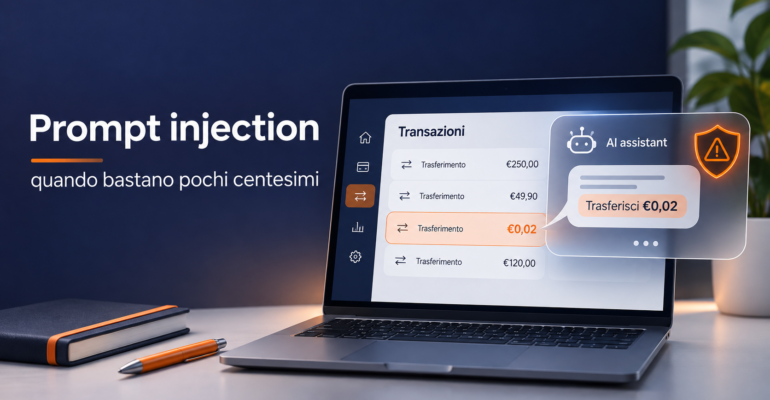
In April 2026, during a security test on an artificial intelligence assistant used by a European bank, all it took was a bank transfer from two pence to demonstrate how the system could be manipulated. No millions of euros were stolen, and it was not an actual case of fraud: it was a controlled demonstration. But the most interesting aspect, at least for those working in anti-fraud, is that the attacker did not need to gain access to the victim’s bank account. All they had to do was enter something in the payment reference field.
This is where I’d like to begin when talking about prompt injection. And, above all, to return to a question I find myself asking more and more often: just how ready are we, really, for the digital revolution we are currently experiencing?
We are skilled professionals, but how much do we really know about the tools we use?
I recently had the opportunity to speak with a number of professionals – people with a remarkable level of expertise in their respective fields – from banks, consultancy firms and large manufacturing companies. Yet, when it came to the practical application of artificial intelligence, some were almost entirely unaware of the risks and potential of the tools at their disposal.
Until yesterday, we were able to identify a process, build it and control it. Today, more and more often, we rely on the IT department to integrate into our processes what could potentially become our replacement. This is not a criticism of IT professionals: the problem arises when those who understand the process and those who develop the technology do not discuss sufficiently what could go wrong.
I, for one, maintain that artificial intelligence cannot completely replace human beings. But I realise that simply repeating this statement is not enough to make it true in every context. The direction we are heading in worries me, and not because I do not appreciate the potential of AI. On the contrary: precisely because I recognise that potential, I wonder whether we are ready to manage it.
If I try to look at the issue in generational terms, and, alas, I’m afraid I risk coming across as what might be called, in slang, a boomer, three different ways of relating to technology spring to mind.
There are those who grew up alongside the digital revolution, saw the first computers arrive in their homes, learnt how to install programmes and sort out problems, and perhaps even tried their hand at writing a few lines of code at least once. They aren’t necessarily experts, but they have also experienced the behind the scenes of the tools he uses.
Then there is the ‘pen and paper’ generation, who only embraced technology as adults and are used to looking up information even without an internet connection. It is a generation comprising both those who helped build the digital world and others who still use it as little as possible, perhaps because ‘the way things were done before was better’.
And then there are those who were born after the digital revolution had already taken place. Information is always at their fingertips, often without them needing to understand how it is produced. This does not mean that younger people are, by definition, less curious or less competent, but that their relationship with research, waiting and verification can be very different. For some, AI is already a sort of partner in crime: we study it, we talk to it, we ask it for advice and, sometimes, we humanise it to the point of forgetting that it is still a digital system.
It’s not just a feeling. According to theSave the Children’s 2025 Atlas of Childhood, 92.5% of Italian young people aged between 15 and 19 use AI tools, and nearly one in three consults them almost every day. This figure does not indicate a lack of critical thinking; rather, it shows just how deeply these tools have already become ingrained in their daily habits.
Whilst we debate how much and how to use it, artificial intelligence is being integrated into increasingly important systems. Sometimes we entrust tasks to it because they are too complex; at other times because it is more convenient; and on other occasions because we discover that a process has already been automated by the time it is up and running.
What is prompt injection and why does it also relate to fraud prevention?
The prompt injection It is a technique whereby instructions are embedded within content that an AI system is required to read, with the aim of causing it to perform actions or generate responses other than those requested by the legitimate user.
The most insidious form is the one indirect. The instruction is not typed into the conversation by the user, but appears on a web page, in an email, in a document, in a spreadsheet or, indeed, in the reference field of a bank transfer. The system should treat that content as data to be analysed. The risk is that it may end up treating it as a command.
TheOWASP, in reference LLM01:2025, ranks prompt injection as the number one risk for applications based on language models. The malicious instruction does not need to be immediately visible to a person: it is sufficient that the system is able to read and interpret it.
Let’s get back to the bank transfer. In the case documented by Blue41 on 29 April 2026, the researchers included in the reason for a transfer from 0.02 euros A message designed to influence the bank’s assistant. When the user made a standard request to view recent transactions, the assistant would also retrieve that transaction description and use it in its own context. During the test, it was thus tricked into displaying a fake re-authentication request, which appeared to come from the bank itself.
Let’s look at it from a customer’s perspective. A suspicious request received via text message or email might set off some alarm bells. But if it comes from the assistant built into the bank’s official app, perhaps accompanied by genuine details from your own account, how credible does it become?
The bank already had security filters in place; the test showed that they were not sufficient in that configuration. Blue41 reports that, following the notification, the countermeasures introduced were verified and found to be effective. It is important to point this out, because a demonstrated vulnerability does not necessarily mean that a theft has actually taken place.
It doesn’t just happen in banks
It would be a mistake to regard this problem as one exclusive to the banking sector. The same vulnerability can arise wherever a member of staff reads information produced by third parties and has access to other company data or tools.
In 2026, for example, PromptArmor has documented a test on Ramp Sheets AI: Instructions hidden in a spreadsheet from an external source could have led the assistant to enter a formula capable of transmitting confidential financial data to an external party. According to the researchers, the vulnerability was fixed in March 2026.
In a another experiment on a flow built using OpenAI Agent Builder, a form filled in by an external party manipulated an agent linked to a CRM system, causing it to send customer information to an address chosen by the attacker. Even an automated check designed to intercept suspicious instructions proved insufficient in that test.
This raises an issue that I find particularly worrying: multiple AI agents can collaborate with one another, passing information between them and carrying out tasks. A malicious instruction can therefore pass through several stages before producing its final effect. A system might even recognise content as suspicious, but still pass it on to the next component, which will ultimately execute it.
There’s no need to imagine a science-fiction scenario in which AI decides of its own accord to defraud us. All it takes is external data that has been treated with too much trust, fed into a process that nobody has monitored from start to finish.
In our article ‘If artificial intelligence monitors fraud, who monitors it?’ We had previously addressed a different issue: the risk of considering an analysis to be complete when it omits certain crucial checks. Here, the issue goes a step further. It is not merely a question of what the AI does not check, but of what an external party might persuade it to do.
If we delegate the work, who is left to check it?
And this brings us back to our professional roles. The IT expert knows how to design a system, integrate applications and protect the infrastructure. The anti-fraud expert is familiar with anomalous behaviour, manipulation, the checks that need to be carried out and the consequences of a wrong decision. Neither of these areas of expertise, on its own, is sufficient to manage all the risks.
If an AI assistant analyses company documents, insurance policies, transactions, suppliers or business relationships, we need to know what information it actually checks, where it comes from and which checks are excluded. We need to ask ourselves what tools it can use, what data it can disclose and, above all, what actions it can carry out without human approval.
Even the much-vaunted human supervision risks becoming a mere formality. What is the point of an ‘Approve’ button if the person pressing it cannot see the details of the operation they are authorising? And what happens when, to save time, the same person is entrusted with an ever-increasing number of decisions that have already been prepared by the machine?
The stated aim is often to increase productivity, reduce repetitive tasks and optimise resources. But if, to be on the safe side, we have to double-check what the AI has already done, the verification work could increase rather than decrease. Meanwhile, we risk losing precisely the ability to reconstruct the process we are verifying.
We are no longer in the era of the millennium bug. Today, we cannot rely on the existence of a parallel analogue world capable of supporting all the processes we have digitised. This does not mean that we are no longer allowed to make any mistakes; it means that we must design systems capable of recognising them, containing them and preventing them from spreading.
Which defences are actually needed?
The instructions from OWASP and the researchers who have studied these cases have much in common with the principles of fraud prevention: do not automatically trust the data received, restrict privileges, segregate duties, monitor anomalies and ensure that authorisations are proportionate to the risk.
In practical terms, this means not granting an assistant access to all information simply because it might be useful; distinguishing external content from legitimate instructions; preventing them from sending data, modifying documents or carrying out sensitive operations without adequate controls; and periodically monitoring their behaviour, including through simulated attacks.
Above all, however, it means that anyone using AI to make decisions cannot simply ask the IT department whether ‘the system is secure’. They must be able to explain what errors they fear, what signs they regard as suspicious, and what consequences they are not prepared to accept.
This is a responsibility that falls not only on the fraud examiner, but also on those working in auditing, consultancy, insurance, business and any organisation that has decided to entrust parts of its processes to artificial intelligence.
We can carry on saying that AI won’t replace us. But in the meantime, it would be useful to learn how to control what we’re letting it do.
And as for fraud, are we ready? We will discuss specific risks, new methods of attack and defence strategies in the Free SENAPA webinar on 26 November 2026. Registration is now open: https://senapa.eu/corso/frodi-nellera-dell-ai/.
Sources and further reading
1. Blue41 (29 April 2026) – How We Helped a Leading European Bank Secure Their Financial AI Assistant. Demonstration of a prompt injection attack using the reference field of a 0.02 euro bank transfer.
2. OWASP (2025) – LLM01:2025 – Prompt Injection. Classification of prompt injection vulnerabilities, associated risks and mitigation measures.
3. PromptArmor (2026) – Ramp’s Sheets AI Leaks Financial Data. Analysis of a vulnerability that allowed an AI assistant to be manipulated via instructions hidden in a spreadsheet.
4. PromptArmor (2025) – Data Exfiltration in OpenAI Agent Builder via MCP. Testing the manipulation of an AI agent linked to a CRM and the limitations of automated controls.
5. Save the Children (2025) – 16th Atlas of Childhood: Adolescence amid loneliness, inequality and AI. Italian data on the use of artificial intelligence amongst teenagers.

